Monday, July 24, 2006

the adventure of having a day off

I have tomorrow off, a weekday. I must say this is the best part of my day job. Even if I work a little on a weekend-- a weekday off is worth 2 weekend days (with banks and post offices actually being open.) The night before is the best part because I get to imagine all the things I'm going to do. After all, I haven't overslept yet so it's still a full day in my head.

Of course my list of things to do is getting a little long... give 75% of my clothes to goodwill because I don't want to wash them... oil prime my canvases with that annoying ground that never washes off my hands... start this new painting I've had in my mind... measure all my artwork and input it into my nifty database... photograph that cluster of pastels I forgot about the other day when I photographed everything else... design new business cards... look for a new apartment/studio to move to.... I could keep going.

Of course I could end up getting to it all since I banned TV before 10pm each day. I've suddenly found myself hyper-productive and have accomplished in a week what I've been aiming to get around to eventually for 6 months. Even though I like to have noise on in the background when I paint-- I can't deny that sometimes it sucks me in and pretty soon I'm sitting on the couch (still holding brushes in my hand) waiting to see who turned out to be the killer this night on one of the Law and Orders. Enough!

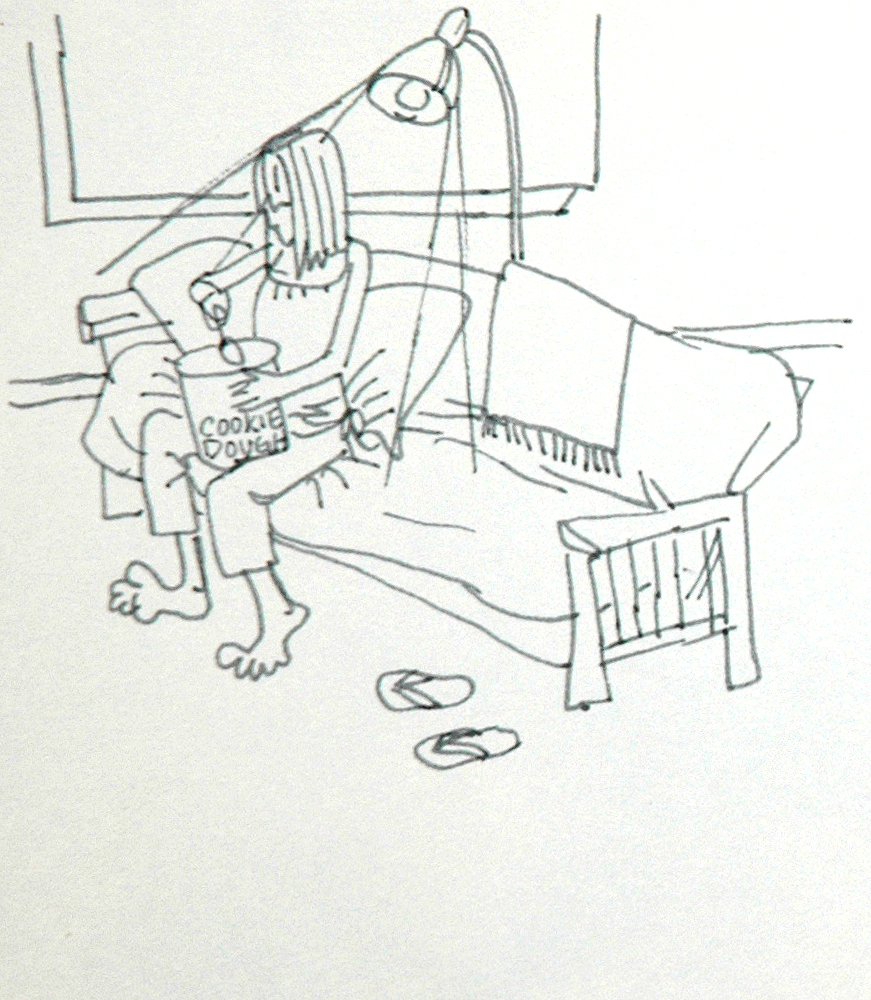
I've also banned desert. Except on weekends and only when I'm out with friends. No more binging on a whole package of Nestle cookie dough while all alone in my apartment.

photohardship

I spent the weekend re-photographing most of my paintings I have in my apartment and I'm amazed how hard it is to get clear images. Of course I'm working with limited lighting equipment and space so I expected it to be an up hill battle. If it's not glare or dust or not being able to get the perfect straight on angle-- it's the inability to really be sure of color in the digital image. I did some paintings in 32K tungsten light (using lights that usually give me a headache with glare) and some in cloudy daylight where the glare is minimal but for some reason all the images came out grayish and lacking a certain fortitude. I really notice the difference when the photos are side by side. Perhaps it is something that photoshop could even out-- but since I have spent years taking my own slides-- a task that requires that everything be meticulous on the photography end-- I prefer to manipulate the images in photoshop as little as possible. So it looks like I have some more photos to re-take. I am not looking forward to breaking out the hot lights and going through my stacks and stacks of paintings one by one.

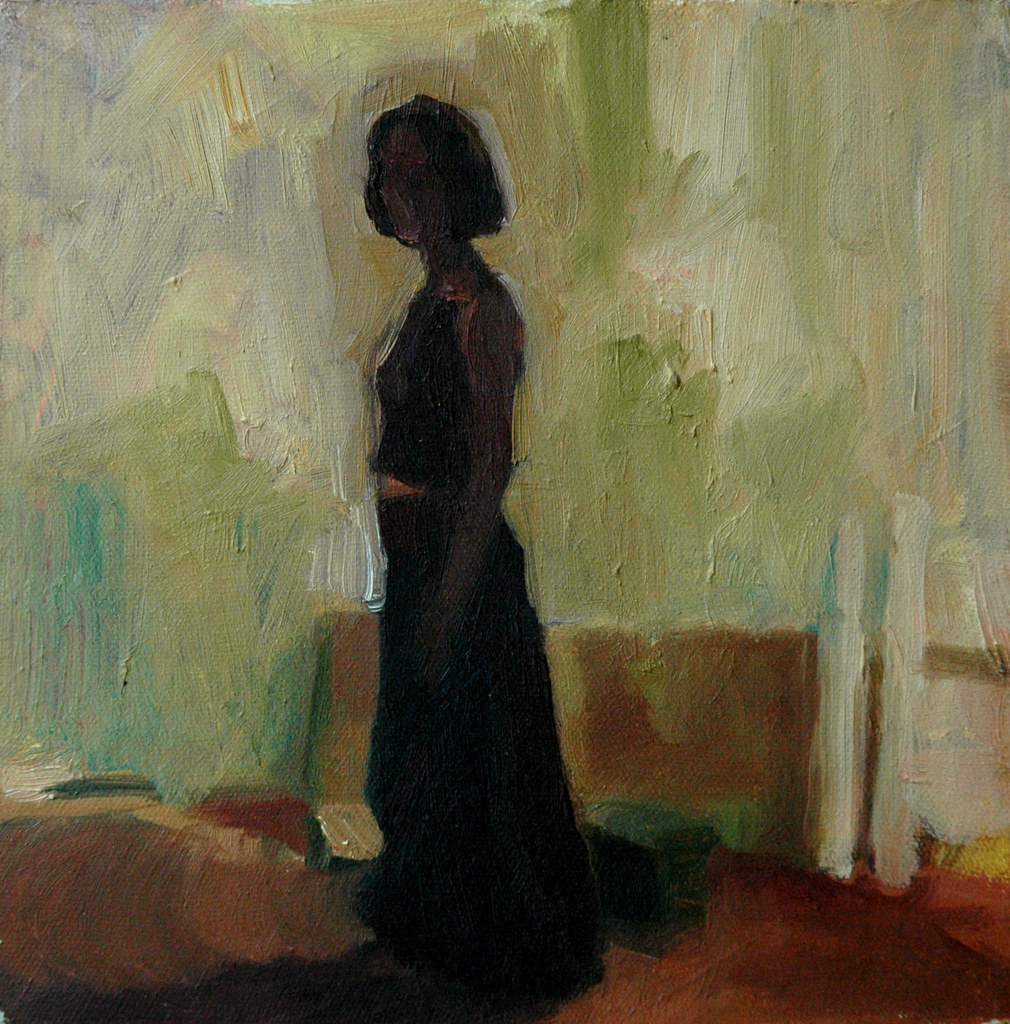
But the upside of me slaving away taking photos this weekend is that I have new images on flickr, many are old paintings (meaning more than a year old) that I haven't posted before. Most of them are either self portraits or portraits of friends.

Thursday, July 20, 2006

my sketchy book

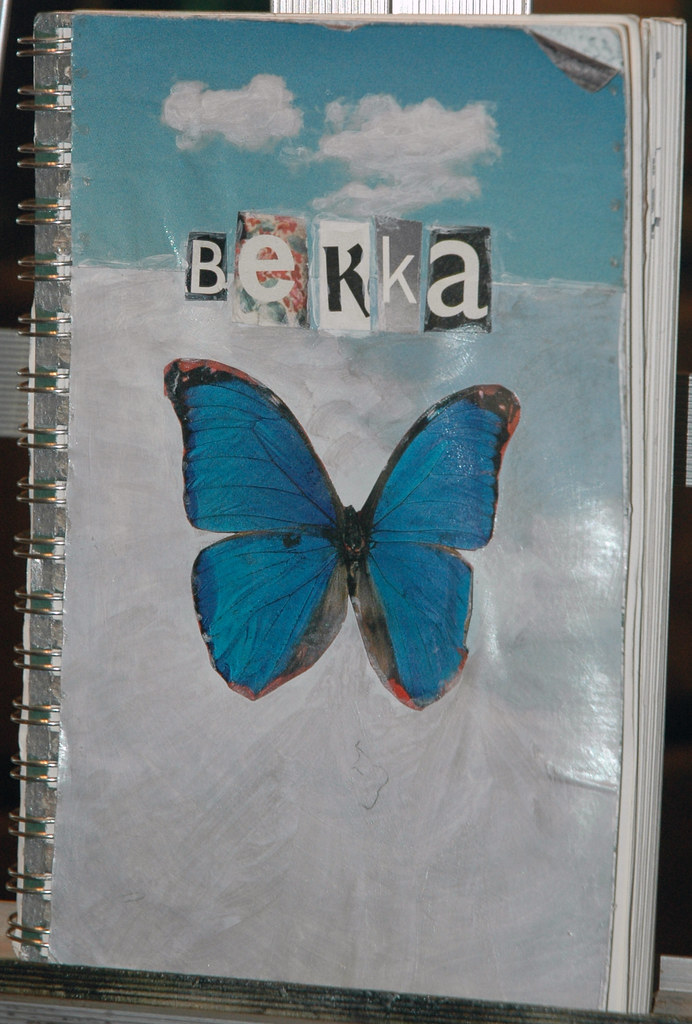
Inspired by the Hockney show to start keeping a sketchbook again (well one that that actually includes sketches and doesn't fill up with phone numbers and random notes.) I have been pretty much been doing a drawing a day-- usually when I'm out with friends or on my lunch break from my day job. I thought I'd post a few things-- nothing is particularly stunning but I like capturing brief moments of people and things I see. I'm pretty good at capturing things quickly before the scene changes too much, and I like the challenge of moving subjects and changing places. Some drawings are interrupted by the subject walking away (or worse, the subject noticing me hiding in a corner looking at them out of the corner of my eye.) So far nobody has bothered me or spoken to me-- that's what drove me crazy a few years ago when I did a group of paintings from sketches made at the Farmer's Market or 3rd Street Promenade. (I'm real popular with old lonely men, and sketching gives them a jumping off point for conversation....) Things that prevent this: sunglasses, headphones. They are an artist's best friend when they are secretly drawing people.

This is a sketch of my friend Guillermo over an impromtu dinner at the East India Grill July 7. We discussed life, our future, Los Angeles, and the magic of double decker buses (I had come from the West Hollywood art ride-- very enjoyable!)


Some sketches over lunch. I love people watching (until they start watching me.)


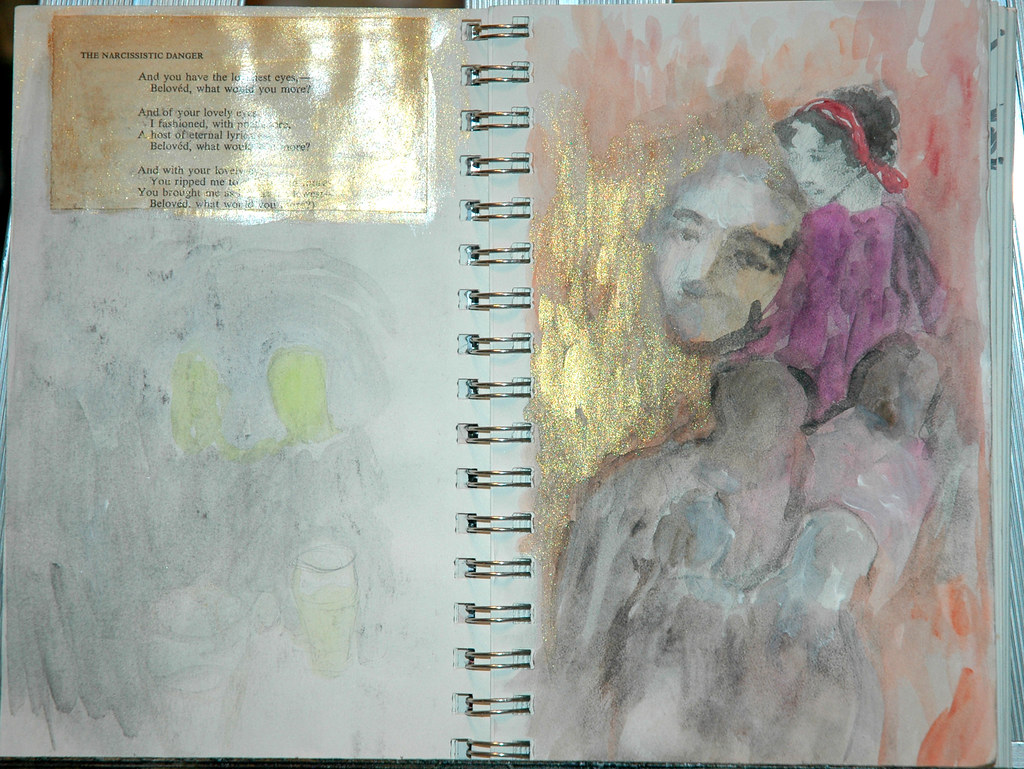
On some of my quick sketches I have started to revisit them later (in my studio) and add to them in what ever way that strikes me at that moment-- usually completely out of my head and very random and impulsive. Sometimes magical things happen. Sometimes it ends up looking like mud.


I'll post more bits and pieces from my sketchbook as they can. More is on my flickr site-- just a start. It will grow...

Tuesday, June 27, 2006

rambling thoughts of the week

Because I'm a lame-o I only just saw the Klimt paintings at LACMA last week (I think, I lost track...) and true to my museum visits the one thing I went to see there turns out to be the least interesting thing to me.

What ended sucking me in was their American landscape stuff (now I'm wishing I had taken notes) but what I have been interested in recently is how location effects art. This is always most evident in landscape painting-- and what I found myself looking at was east coast landscapes vs. west coast, bare desert hills vs. dense, lush forestscapes. It stood out to me because I always hated landscapes and painted pretty crappy ones if I ever did (I had multiple art teachers tell me to not try them again). But that was on the east coast. The second I come to California I started painting/drawing landscapes every week. At first it was because I didn't know anybody and I didn't have any friends to model. But then I started getting into the landscape here. What I found was that I was just more drawn to paint the California geography. CA is more solid and concrete with grassy hills, rocky mountains, distance, as opposed to the dense bushes as opposed to the lush all-over greenery of Massachusetts. This was suprising because I was (at the time) prejudice against places with real trees and forests. I lived in the west until I was 11 and spent my whole childhood dreaming of tall green trees and hating the dead desert yellow color of everything around me. I'm kind of surprised I'm on this end of the country, but I've fallen in love with it- and the paintings it makes me do.

The other thing at LACMA that I saw was the Hockney exhibit. I can't say that I was a big Hockney fan before but I really enjoyed this exhibit for several reasons. First of all, I love portraits and figures of any sort. Could look at them all day, almost did. Also, again I'm really intrigued by the location an artists chooses to work in and how it inspires them-- or just seeps into their work. Sometimes I wonder if the whold NYC-starving artist thing limit's POV. I personally think that-- art being inspired by real life-- lives or dies based on what an artist surrounds themself with. And an artist like Hockney that incorporates his life so directly in his work is a very good example how an environment (social, geographic, cultural) plays a role. Just looking at his color choice-- turquoise, mint green, dusty rose, etc.-- these are not colors inspired by the northeast.

The last thing that the Hockney exhibit taught me is that I need to frikkin' start sketching more. I used to carry a sketchbook every where I went and would sketch every minute I had a down moment. The habit slowly faded when I stopped doing paintings strictly from sketches of brief real life moments. But even if I don't paint from my sketches, it is a fabulous way to slow down the process of observation as well as just get inspired.

That's all for tonight. Gotta go wash my brushes. (And my dinner dishes too probably while I'm at it, they'll get smelly.)

under a cloud

I've been painting a storm the last few weeks trying to finish off all I've started recently. I'm notorious for starting 20 paintings and working them all at the same time which makes an odd feeling of being both prolific, and moving at a snails pace because nothing ever is completed. I also never call a painting done. Paintings I called done last October got dug up and fiddled with of late. Part of this is that over time after I stare at my stuff I notice things that could be better crafted. Of course this week I've found that this habit of mine is more like picking at a scab than brilliant technique. I've found my skills have gone into crap lately because suddenly all my brushstrokes and color choices and pretty much everything is clumsy and muddled. I'll spend hours focusing on the dappled light falling on a cheek of a woman- and then when I take a step back it looks like a monkey with a beard. I've always had weeks where my flow seems to be off and I just work through it. Though sometimes I just paint like crap because I'm feeling lazy and impatient and am not channeling my full attention to what I am doing. But I'm embarrassed that whatever funk I'm in is out of my control at the moment. It hits me everytime I walk past my "studio" and feel the eyes of my bearded monkey women.

Tuesday, June 06, 2006

oh snap!

So I'm a compulsive canvas builder, even when I don't need canvases I find myself building them for a rainy day. So I had a day off today and first chance I got I went down to the store to get some canvas. Because the Pearl near my house is poorly stocked, and maintained-- when I got there they were pretty wiped out of canvas. All they had was 84" wide of the canvas texture I wanted-- wider than I needed but I took it anyway. At first I asked for 2 yards since I was only building 2 canvases, but then I got greedy and asked for a third yard (so I can save myself a trip to pearl on another rainy day...) When they unspooled the roll that extra bit for me, it turned out that after my 3rd yard, there was only 1 yard left on the roll. So they just gave me that extra yard for nothin'. Bonus yard of canvas=grrrreat day.

Thursday, May 18, 2006

a new hope

I've been a little scattered lately because I am in the process of switching day jobs. But ultimately I think this will be a good thing-- once it's all sorted out and a routine has been set. I'm a little nervous because I never seem to get the balance I need to paint full force but of course even in the days when I had all day to work I still was short on time. Painting is addictive, and the more time I spend painting, the more time I need for it.

But the best thing about switching day jobs is the hope and the motivation it is giving me. I've reached that point where I feel like I have been waiting for my life to begin but never quite living it. I think it's a trap that many aspiring artists of all sorts fall into in LA. Everyone here is waiting for their big break. The key word is waiting-- which means everybody is waiting for something to actually happen-- like their life. At some point a person realizes how much time they have lost thinking they will get rich and successful tomorrow or the next day and then has to come to terms with the fact it may not happen, and if it doesn't-- what does that mean to their goals, identity, and happiness.

So I have decided to not wait any longer and start living the life I want to. Of course I have no money, but this new job gives me just a little more so that maybe I can change just a little bit.

First thing I need is to move. I need to not have a roommate-- I don't like having my schedule dictated by another person in my space. (Plus I don't like having food left to rot on the counter.) And I don't particularly like my apartment. The light is poor, the carpet is ugly, and there aren't any people my age in the area. So I must find a way to find an apartment with good light, young artists nearby, no roommate, and preferably hardwood floors. I would like a loft but unfortunately I think it is out of my price range so I will probably still have space issues. Also, I would like to get a cat. Preferably with a bizarre name that requires an extensive explaination. After this, I need to connect with other artists in LA. I seem to be having trouble with this (but I do know a shitload of screenwriters and aspiring directors...) and I've been told to "go to openings" but it would help if maybe all the artists could just put an "A" on their chest or something so I could pick them out. And lastly of all a show would be nice. I've gotten several rejections this year which prompted me to paint harder and faster. I'm hoping it pays off soon, otherwise I'll just put something together myself because I'm never one to wait for an opportunity to be handed to me. I make my own.

But needless to say, the next 6 months will be transitional months. However I'm looking forward to a life that involves more serious painting, artsy friends, wine, and real health insurance.

Monday, May 15, 2006

musings on landscapes and more

I spent all day Saturday at the Getty staring at paintings. What I like about looking at paintings I've seen before is noticing new details I've never seen in them before. And these are details I rarely grasp from reproductions as I hunted for decent links to the few paintings that really stood out to me this visit and couldn't find a single one.

So this weekend-- while I was originally aiming to see the Courbet exhibit before it went away (and more specifically looking to see how the color green is used in his landscapes...) -- I ended up getting inspiration in the Italian painting section instead. After finding Courbet and other plein air paintings in the permanent collection rather dull this visit (not that it is dull, it just didn't strike me this time around) I thought I would open myself up to more than just plein air painters. I wanted to see different takes on landscape. This is how I found myself in the Italian Renaissance. What intrigued me was not the figures (which is what I usually obsess over) but how everything else was arranged and painted-- the landscapes, the cities, trees, blades of grass, leaves, flowers, clouds, etc. This painting, for example, was one that particularly spoke to me.

I am not an expert on anything Renaissance (it seems as I get older and more disciplined I am starting to find holes in what I know. After this weekend I have decided to invest in several books on the Renaissance to satisfy my need for more knowledge.) What I am curious about is how a painting would be constructed using various elements.

Going back to the painting by Dosso Dossi as an example I deduced the following based on observation. Objects like the vase, the broken crushed flowers, maybe some of the foreground earth were probably done from life (maybe in sketch form first). I don't know how much of it was in one place at one time. Surely the flowers would have wilted in the time it took to paint them so I assume there were sketches and studies done-- the finished product done based on those. I am not sure of the ground beneath the figures, but looking at some of the other paintings nearby in the gallery I got obsessed with feet-- mainly because the figures in many of the paintings were not very well set into the space suggesting the models were not posed in that location. In the Dosso Dossi painting this is less of a problem-- however the legs of the centaur on the right side are unnaturally in shadow which for some reason I assume was because he had trouble painting what he couldn't observe and maybe played it down a little bit by letting it fall into deep shadow. I could probably assume all the figures were posed and worked from seperately. There seems to be very subtle shifts in scale, perspective, position in space that doesn't quite seem natural. The background is a whole other monster. The separation between foreground/background is very distinct as if the background was more of a backdrop than a continuous landscape receding into the distance. I am guessing the background was not drawn from life, but is a compilation of familiar elements arranged to serve the theme of the painting. The landscape seems more like a fantasy-- something drawn from imagination rather than life. The leaves are painted wit a certain pattern like quality and the color seems more literal as if from memory as opposed to life.

Many of the paintings I looked at had a bizarre dichotomy: beautifully painted luminous figures set in landscapes that seemed unreal and not quite sharing the same space as the figures. But at the same time-- this seemed to be done accomplish a point and they get away with it.

This way of painting the lanscape is very opposite to the plein air painters I also looked at. I thought that plein air landscapes would be more helpful to me-- after all they were painted almost directly from life. And isn't painting from life far superior? After looking at all these paintings I am not so sure. I think that painting out in the landscape is a great learning tool-- but when it comes to the core of one's work-- the real key is to figure out what your painting is all about. And what I realized this weekend is that-- yes-- lately there has been alot of landscape in my paintings. But my purpose is not to capture the landscape nuances accurately. I am trying to create a sort setting that has a subtle feeling of fantasy-- of an imagined or subjective landscape. I am thinking I may start making my landscapes more unreal on purpose and see what comes of it.

Wednesday, May 10, 2006

van Gogh on painting & photography.

"I am working on a portrait of Mother, because the black-and-white photograph annoys me so. Ah, what portraits could be made from nature with photography and painting! I always hope that we are still to have a great revolution in portraiture." October 9, 1888, Letter from Vincent van Gogh to Theo van Gogh.

Thursday, May 04, 2006

it's the size of the mark and the canvas that counts


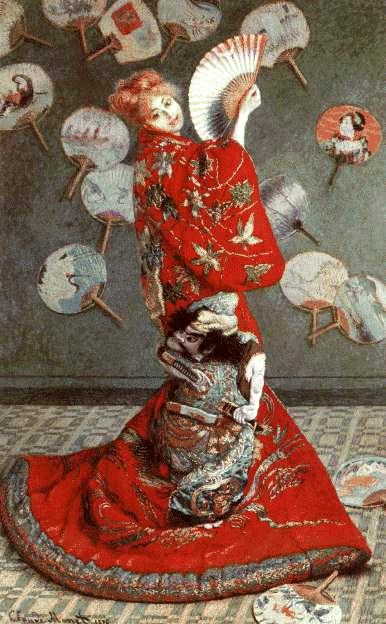
The last series of paintings I have done are relatively small in size. For example the one on the right, "Away" is under 2 feet. Certainly going to any gallery with contemporary paintings, 2 feet feels exceedingly small. However if one takes a look at some of Degas' work, it is surprisingly small. Off the top of my head, most of the impressionist work I've seen is small (I'm thinking of the MFA Boston collection in particular because that is where I spent many long hours looking at it when I lived in the area.) The only larger size paintings that I remember are Monet's "La Japonaise" (roughly 232x142cm or 7.6x4.7feet)which dominates one wall of the room, Manet's "Execution of the Emperor Maximilian" (roughly 196x259cm or 6.3x8.5 feet), and Monet's almost abstract large scale water lily paintings (which I saw at the Monet exhibition, they are not part of the MFA collection.)

In art school there was always the pressure to paint big (over 6 feet big) which at the time I, being 19, thought was only an example of "bigger-is-better-itis" that is inflicting our patriarchal consumerist society, those are the terms I saw the world in then. I held out for a while, arguing that most people don't have space to hang 7 + foot paintings in their homes so they're really not marketable (not really grasping that most people can't afford to buy paintings for their homes) and then begrudgingly went about making large paintings. The problems I had in art school with size and scale were numerous. Often I would make the same paintings I would make small, but just increase the scale. Many of my paintings were giant faces which made my art teachers fill my arms with books and books about Chuck Close and of course I didn't understand why. And on top of painting giant heads, I had no money and only bought cheap tiny brushes giving everthing a very uniform brushstroke throughout. Again, I was not aware I was doing this though art teachers told me. But this last year it has been like all the things I was being told in critiques just sunk in and now I understand what I didn't when I was 19.

Now that I have no teachers telling me to paint bigger, I have finally been able to paint small. And it was seeing some tiny Degas (don't remember which ones or where) that moved me to follow my gut. While the paintings were small, it were of full figures and settings, and fully realized. If seen in a book one would probably assume it was much larger. But what really compelled me was the fluidity of the paint-- how a single confident brush stroke could high light at arm-- that was all it took. I wanted to do that but I always had too much area to fill in with a tiny brush. So I starting painting small scenes and really working on building my brustrokes, color, and confidence. By working small I started to master the paint more, get a better feel of it.
And after really working like this for a while, I felt the need to get larger. So I made larger canvases. And this time I really paid attention to the relationship between the viewer and the painting. First of all, if painting a figure larger than life size-- it stands out as larger than life. There are two reasons to paint larger than life: to give an overwhelming effect to the up close viewer, or appear life-size to the viewer if the painting is displayed up high or at a distance. I did not want to overwhelm the viewer-- not like Chuck Close. (Why is it that a viewer can relate to smaller figures rather than huge ones in pictures?) So with my larger paintings I took great pains to scale my subject proportionally with the frame of the canvas-- though still larger than my smaller paintings. And as I paint the larger paintings, I paying attention to the proportion of the brush to the painted image as well as the canvas. If I vary the size of the brush, I can control the focus of the painting much like a camera-- though not in planes of depth of field but in how the eye travels. The eye will go to areas with finer detail and more painted work. And if I contrast the fine detailing with broader, bigger, and bolder brushstrokes, the eye will interpret that as more peripheral. Plus having worked small for a while and mastered a small amount of paint, it is really showing in the larger paintings. They look more confident than my old paintings, and that is good. I hope to someday be as good at painting as I am at drawing (another thing that was told to me in art school. ) Though I still don't know why, in todays world where there hardly any frescos and murals, there is the pressure to make giant paintings-- as if that makes one a serious artist. I know that it is unlikely that I will go larger than 7'anytime soon-- at least until I get more space since my ceilings are only 7'6" high. I will post some of my college/high school work for contrast some day.

More on Brandeis

While following up on the recent move by Brandeis to pull an art exhibit of drawings by Palestinian children, I came across this article which will make more context in light of this (including comments.) (via)

Wednesday, May 03, 2006

Upsetting, but not surprising

This morning checking headlines I came across this in Modern Art Notes. Brandeis has apparently removed an exhibit of drawings made by Palestinian children that was put in their library by a Jewish-Isreali student and former member of the Isreali army. The argument? It was offensive to students and was declared one sided.

First of all I agree with Tyler Green that an art exhibit does not need to show balanced opinions. And I think that removing the exhibit shows a respected university's weakness that it must at some point face if it hopes to continue to say that it is a non-Jewish school (well, on paper maybe) and if more than that, if it wants to continue dreams of keeping it's place in academia.

But I am not surprised by the Brandeis reaction being an alumn myself. While some put the percentage of Jewish students at 50%, when attending Brandeis it feels much more like 80% and I would be curious to hear actual numbers. Personally I am not Jewish but have an interesting background having lived in Jerusalem for a year as a child where I attended an Israeli public school. Although I was young then, I got a unique sense of the conflict. Because of my family's background and reasons for going to Israel (which I won't go into on a public blog) I visited a few places like East Jerusalem and Jericho. Yes, I was a child and didn't know the complexity and politics of the situation-- but being approached by a Palestinian child (about 8) with no shoes living in a ramshackle shed of a house trying to sell me candy in order to support his family is something that sticks in your mind. Being only 12 myself, I found myself giving the child my entire allowance and turning down the candy that I wasn't really interested in. But the Palestinian child insisted I take the candy so I did. It was experiencing things like this that I became very curious about the Palestinian experience-- the one that is not represented on American television. And while I'm not necessarily booksmart about the conflict-- I left Israel firmly believing that there is a story of Palestinian life that is not heard.

At Brandeis, I could never express to my fellow students that I believed Palestinians had rights, including the right to government representation, or more than that the right to their own state. The allegiance to Israel is strong among students at Brandeis, and all the years I attended, the discussion of the MidEast conflict was one-sided on the side of Isreal. I remember even apolitical Brandeis students get riled at any person who dares suggest what I suggest. There I became accustomed to staying silent on the topic.

So when any portrayal of the Palestinian experience appears on Brandeis campus-- it is not one sided. It is the first glimpse of Brandeis actually having a balanced opinion and it is unfortunate that the university chose to censor progress.

Tuesday, May 02, 2006

shifting gears

I have slowed down on the painting the last week which I feel guilty of but really there is just not time in the day for me to accomplish everything. And this has become a week to get all those small nagging real life things done-- the things I put off because painting is more enjoyable. But at a certain point all the small things become a big monster that kills the creative impulse. And that's what has happened this week.

I did purchase my camera finally, and spent several hours documenting every leaf and blade of grass in a mile radius from my house. Though once that was done I had to turn to housecleaning (my apartment was starting to smell) and mundane bill-related tasks. I am hoping to do a little bit of spring cleaning and reorganization of my life so that I will have a more comfortable mental and physical space to paint in, as well as better time-management so I blog more often. (I have several dozen half written blog entries that I never posted and I hope to change that by setting aside more quiet time to finish things.)

But with my new camera I'm anxious to take some real pictures (not of blades of grass and leaves) which I will do this weekend as I have persuaded several of my friends to pose. Though I inadverently started a side headshot/portrait business and already have 3 appointments this weekend. I've never really done headshots, but somehow I'll muddle through it all the while pretending I know absolutely what I'm doing.

Thursday, April 27, 2006

Artistic Risk

Julian Jones asks "Do rich artists make bad art?" I don't know if it's necessarily simply a money thing-- it seems like a much more complicated issues. I think the question is whether recognition, fame, fortune, celebrity, etc. make it difficult for an artist to keep their eye on the ball. Perhaps after entering in the limelight and becoming a celebrity of sorts, there is a tendency to loose touch with one's world. With celebrity there comes a new set of responsibilities. While any artist loves to get paid, the business people attached to the artist depend on the artist to continue to rake in the money. Once an artist becomes successful-- they become a product-- something to be marketed. Understandably some artists can flourish under these changed circumstances, and some can not.

Jones does point out several "rich artists" that were good artists in spite of being successful. What is different in these artists make up that allows them to keep creating great work? Is it that some artists care more about art than the money? Or is it a difference in thought process? Or is it that some artists are willing to take the risk of potentially alienating their business associates, audience, and critics?

Wednesday, April 26, 2006

mundane events of the weekend

The highlight of my weekend turned out to not be visual art related. Friday night I ate at San Genaro in Culver City which-- despite living within blocks of it for quite some time-- I have never tried. And I won't try it again. While I like the old time crooner they had and the couples dancing on a dance floor-- it just reaffirmed my opinion that if a menu is more than 4 pages long, don't trust the restaurant. But after dinner my friend and I went to Largo where Aimee Mann gave an unadvertised performance. I have never been to Largo-- but it's now my new favorite place. Just the fact they'll kick out anyone caught with a cell phone out in the open sold me alone. But sitting at a table drinking martini's four feet from Aimee Mann as she performed any song the audience requested was definitely one of my best live music experiences.

After that, I was in a permanent good mood for the weekend. I didn't get to the Getty or LACMA as I had hoped (my to-do list contained about 3 yrs of tasks pretty much) but I did get to some of the galleries in Culver City. Much of if was nice but not relevent to what I'm doing these days-- but I did like the suburban landscape paintings by Rick Monzon at George Billis. Since there's a large landscape element to my paintings lately-- I've been taking the time to really look at every landscape approach I can for inspiration. Since then I've spent every minute reworking several of my paintings. Though I don't know if I made them better or worse right now. I've gotten so used to them being in the state they were that now any changes feel out of place. I'll keep painting on them because I find that in the development of any painting-- things get really muddy and awkward just before they become brilliant. So if I relax and just keep painting hopefully I will get there. But I definitely need to get out to the Getty this weekend to see the Courbet exhibit.

I have come to a decision regarding the digital camera problem and by the end of the week I will have a brand new one. And once I do I will return to posting pictures of what I'm working on and what I've seen lately. I've done so much and thought about just blogging about it in words-- but that doesn't really work well.

Tuesday, April 18, 2006

cleaning out my mind studio

lately i've turned to cleaning and building to help usher in a new era of painting.

when i'm stressed, too stressed to think coherently about color and brushstrokes, etc., I turn to building canvases to get my restlessness out of my system. there's something about using power tools, hammers, and massive staple guns that is theraputic.

this week I'm pretty much working on a bunch of canvases. it's one of those things that you think will take a day and ends up going on for a week and a half-- and it only stops there when you run out of screws or canvas or staples. now I'm getting anxious to call it done, because at a certain point one starts feeling like they're not moving forward and wants to return to image making.

right now I'm planning a bunch more paintings. I have about 20-something ideas and I'm trying to move on them as fast as possible. I wanted to have models in the studio this last weekend but after my camera broke I got discouraged. (yes, i use photos religiously. would love to paint from models more but I have a severe lack of money for them.) so I must go and purchase a new camera by this weekend so I am not deterred any longer. but in the meantime I am preparing everything so that once I'm done with sketches, research, photos, planning, I can fly fast into the core of the painting without prepping surfaces.

my new daring prospect is that I have, for the first time, been approaching appealing people on the street and asking them to model for me. all through school it seemed I was limited to what models the department paid for or what friends I could pull out of the library and into my studio. and I was plain shy to just go after what I want.

after seeing the Sean Cheetham exhibit at Mendenhall Sobieski I was inspired to find interesting characters-- not necessarily like his. But my own characters. It perhaps is also because so many of my paintings in the past have been self portraits, and I'm rebelling against that and removing my own image from my work. I had a friend who once commented (on a painting that was not of me) "You know what you've done, you've painted yourself into the painting." She knew it was not me in the painting, but it seems no matter who or what I paint, it is always a self portrait. Perhaps I want to escape that. Though once I do I will have to face the question of what is my painting of-- if not of me? And somehow finding models farther from what I identify with will push me more to really think about what my art is about.

the other thing I'm trying to get my head around is what makes what I'm painting now unique to this time, place, decade, generation?

I honestly obsess over this since I want to push the envelope but within figurative art. I believe representational art is never out of style as long as people have eyes and enjoy looking at the world around them and reinventing it. but what is important to me is how it is done today, versus a century ago. as well as what can I add to it's development, and whether I should go after painting something new and shocking for the purpose of being new and shocking.

So many thoughts and questions. I desperately want to return to the simplicity and meditation that is stretching canvases. Adieu!

Tuesday, April 11, 2006

gallery recap

There's never enough time get out to museums and galleries on a regular basis between my painting and trying to pay my bills. But I did manage to get out of the studio this last week and figure I'll give a report.

Generally I am a very selfish viewer of art. I want to see things that inspire my own work, and write off the irrelevent. Which is why I feel compelled to write notes because it makes me articulate better what I have seen and what I think about it. Otherwise I would be speedwalking through galleries and not taking the time to appreciate things I see.

Amy Wheeler/"Pretty Vacant" thru 4/22
Shoshana Wayne Gallery

From a distance I was drawn to her work. But as I got close I personally felt some of them were underworked. She uses a lot of thin washes of paint in the background with vines and leaves painted over it with carefully placed brush strokes. (couldn't pull images from the site but you can see them if you click the link.) Some used airbrush, and were more worked, others were on the minimal side. I loved the color and the composition and the design quality. I have a personal preference of being able to see layers of paint and a hint at its history and development beneath. Which may be why I felt they were underworked. I had an art teacher tell me once that a person will spend as much time looking at a painting as you spend making it. And I felt this comment was somehow relavent here.

I also felt there was an emphasis more on positive space-- painting the vines/leaves on the background instead of painting the background around the contour of the vines-- or working back and forth between the two. My painter instinct would be to work this way. Or to very pointedly avoid it.

The one painting that stood out the most was called "Silver" which I liked because the contrast between the marks of the plant and the airbrushed shadow and the paint in the background. I also liked the nuetral color ones in the smaller room, especially the way the airbrushed white plays in it.

Rosamund Felson
A Play on Action: 5 Los Angeles Artists Consider Feminism, thru 4/15

The artist that caught my eye here was Corrina Peipon. One piece, "Things" specifically caught my eye. It was simply sheets of white paper with type written phrases on them-- all realating to possessions. (Stupid me did not transcribe the text as I wish I had.) I am not sure of the background of this piece-- whether the words were written by her or taken from another source as I know another piece of hers there was.

But the reason this piece struck me-- well, to go into the background of why it did-- I have been obsessing over art containing text. I don't necessarily think it's a bad thing, though often it is not incorporated well. And I don't know if it is just me noticing it more lately or it has been popping up more often, but from my perspective it seems to be spreading like a disease. Okay, so that conjures up too negative an image I admit. (I should add I've been obsessing with it because text has been popping up in some of my own work too.) When text is done wrong in 2D art it's like the artist is hitting the viewer over the head with a bat.

But what really caught my eye in Corrina Peipon's piece is that it is entirely text and simple paper, type-writer text phrase on each page, hung on a wall. And it comes across as sort of a poem-- and the content of the text carries it-- not blatently trumpeting some message oriented meaning. But much more subtle. And this led me to thinking that it is interesting to just exhibit a poem on the wall, plain and simple. Text as art. That got me thinking, well to compare this to shift within the poetry world to read/perform the work aloud which-- in my limited historical knowledge of the genre-- was a 20th century change. But to hang up plain text flirts with the different modes of experiencing art.

I'm sure I will be stewing over this idea for a while.

I still have 2 more shows I want to write about, but it's getting late and so I will have to pick this up again later. Especially because one of them will probably generate notes the length of a novel and when I'm home I prefer to be painting than writing about painting (ah, priorities!)

I'll just end with the question that is on my mind tonight as I write this:

What role can text play in 2D art? What makes it work?
Monday, April 03, 2006

busted and broken and purple

my digital camera has broken. i feel like an artist with no legs. suddenly so many things I want to photograph and can't because if there is any white or light source in the image, it will appear purple in the photo. according to a camera repair guy who had slightly more digital camera knowledge than the guy I bought a muffin from this morning-- it's not worth repairing. then he tried to sell me a new camera package for $1000. the camera I have now cost me $700 in 2004. i've taken somewhere between 3000-6000 pictures with it. he says I wore it out. i'm still suspicious of his opinion. needless to say, i don't know that i need to spend $1000 to replace it. i could get something far superior to my broken camera for $700. and the only difference between the $700 camera and the $1000 one he tried to sell me is a longer lens and a camera bag. the camera body is pretty much the same-- and I wouldn't know the difference because i'm not doing heavy continuous shot stuff where i would feel restricted at all. and either way, it's all better than what i've been working with so i don't think it will matter at all. now the only question is do i want to spend the $700? i don't know. i feel like i should make the camera pay for itself and go photograph weddings and do headshots and stuff of that sort. but i don't know if that's my calling. i'd rather spend my weekend photographing interesting cracks in the sidewalk for free and not have to deal with people and the service issue. but needless to say, until i figure this issue out, images will be absent from this bloggie.

Wednesday, March 29, 2006

my shadows

shadow1

shadow2

it's nearly 2am and I'm getting sloppy but I wanted to post these little sketches that I did this week. somehow I had the idea to draw shadows completely removed from their context-- leaving a distored shape of the figure. somehow this way of drawing the figure (without including the figure, or any physical objects) is interesting to me-- and I want to push it further and keep playing with the idea. btw, they are charcoal & acrylic on gessoed paper and are all about postcard size. perhaps I should actually do them as postcards if I do any more. there are more of these on my flickr site too. and now to bed....

Monday, March 27, 2006

uploading, organizing, and pulling out my hair...

yes, I still really don't have any comprehensive internet location for my own artwork. my website has been in process for months and still I don't feel I can refer anyone to it without prefacing the state of it. it doesn't contain a single image I like personally or feel represents "my work." so lately I have turned to flickr for an intermediate place to upload stuff. why? because it's fast, cost effective and requires no "designer". it still won't be as together as I would want my final artist site to be, but for now it will serve as an informal place to view my work.

what's odd about organizing my own work for other's eyes, I realize my work style is pretty far flung-- or it seems to me. I like to be consistent because that always looks stronger, but it is just my nature to swing back and forth between diverse styles. in reality I can be very prolific and sticking to one style would feel like prison. really I have so many ideas and follow so many trains of thought that it would be hard to just do the same thing over and over in the name of exploring a concept. I wonder if other artists face the same thing.